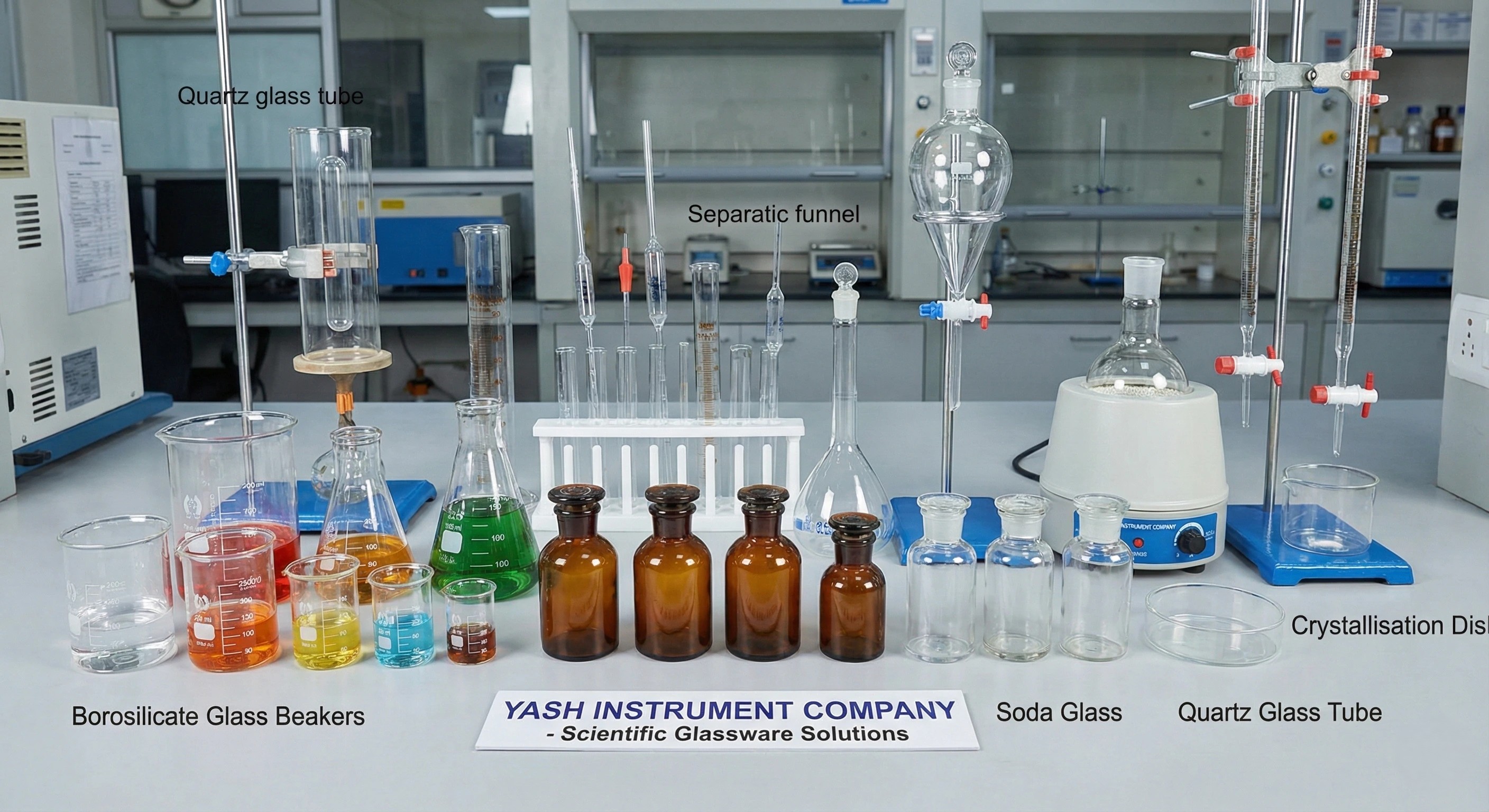
Laboratory glassware is not a single category — it is manufactured using different glass formulations designed for specific chemical and physical stresses. Understanding these materials is the first step in ensuring laboratory safety and experimental accuracy.
At Yash Instrument Company, we strictly adhere to international standards (ISO/ASTM) to ensure our glassware meets the rigorous demands of modern science.
Types of Glass Materials Used in Laboratories
Different experiments require different thermal and chemical resistances. Here are the four main types of glass we manufacture with:
1. Borosilicate Glass 3.3
The gold standard for laboratory use — contains silica and boron trioxide for exceptional performance.
- Properties: Excellent chemical resistance, high transparency, and a very low coefficient of thermal expansion (3.3 × 10⁻⁶ K⁻¹).
- Use Case: Ideal for heating, boiling, and aggressive chemical reactions.
2. Amber-Coloured Glass
Borosilicate 3.3 glass with added coloring agents (iron, sulfur, and carbon) to block light.
- Properties: Blocks UV radiation up to 500 nm wavelength.
- Use Case: Storage of photosensitive chemicals like silver nitrate or vitamins.
3. Soda-Lime Glass
The most common commercial glass — low cost but limited thermal tolerance.
- Properties: High thermal expansion (prone to cracking), low cost.
- Use Case: Class B volumetric ware, storage jars, petri dishes. Never heat soda glass directly.
4. Quartz Glass (Fused Silica)
High-purity glass made from pure silica for extreme applications.
- Properties: Withstands temperatures up to 1200°C and transparent to UV.
- Use Case: Cuvettes for spectroscopy, high-temperature furnace tubes.
| Material | Max Temp | Thermal Shock Resistance | Cost |
|---|---|---|---|
| Borosilicate 3.3 | 500°C | High | Moderate |
| Soda-Lime | 100°C | Low | Low |
| Quartz (Fused Silica) | 1200°C | Very High | High |
Scientific Glassware & Their Applications
We manufacture a wide range of glassware. Here is how each type is used in the laboratory:
Beakers
Cylindrical containers with a flat bottom.
Application: Mixing, stirring, and heating liquids.
Graduations are approximate (±5%).
Erlenmeyer Flasks (Conical Flasks)
Cone-shaped body with a narrow neck.
Application: Titration (the shape prevents splashing), boiling, and recrystallization.
Volumetric Flasks
Pear-shaped with a long neck and a single graduation mark.
Application: Preparing standard solutions with high precision (e.g., 100.00 ml).
Never heat these.
Burettes & Pipettes
Long graduated tubes.
Application: Dispensing known volumes of liquids during titration (Burettes)
or sample transfer (Pipettes).
Desiccators
Heavy glass jars with a ground-glass lid.
Application: Drying samples or keeping substances moisture-free using a desiccant.
Frequently Asked Questions
Why is Borosilicate 3.3 preferred for labs?
Borosilicate 3.3 has a very low coefficient of thermal expansion, meaning it can withstand sudden temperature changes (thermal shock) and high heat without cracking. It is also highly resistant to chemical corrosion, making it the safest choice for most laboratory procedures.
What is Amber glass used for?
Amber-colored glass stores photosensitive (light-sensitive) chemicals. The dark tint blocks UV and infrared radiation, preventing chemicals from degrading or reacting when exposed to light. It is commonly used for silver nitrate, certain enzymes, and pharmaceutical compounds.
Can Quartz glass withstand higher temperatures than Borosilicate?
Yes. Quartz glass (Fused Silica) withstands temperatures up to 1000°C+, whereas Borosilicate glass is typically rated for up to 500°C for short periods. Quartz is used for furnace work and applications requiring UV transparency.
Conclusion
Selecting the right glass material is crucial for the safety and success of your experiments. At Yash Instrument Company, we ensure all our glassware meets the highest standards of quality and durability — so you can focus entirely on your science.
Need High-Quality Lab Glassware?
ISO-certified borosilicate glassware — made in Ambala, shipped worldwide.