Laboratory glassware is the backbone of scientific research, chemical experiments, and industrial testing. At Yash Instrument Company, with over 20 years of experience as a leading manufacturer of high-quality lab glassware in India, we understand that precision, durability, and safety are non-negotiable.
Table of Contents
Whether you are a researcher, educator, or exporter, choosing the right glass material can make all the difference in your experiment's success. In this guide, we explore the science behind the glass.
Types of Glass Materials Used in Laboratory Glassware
Lab glassware isn't one-size-fits-all. Different chemical compositions offer unique properties regarding thermal resistance and chemical durability.
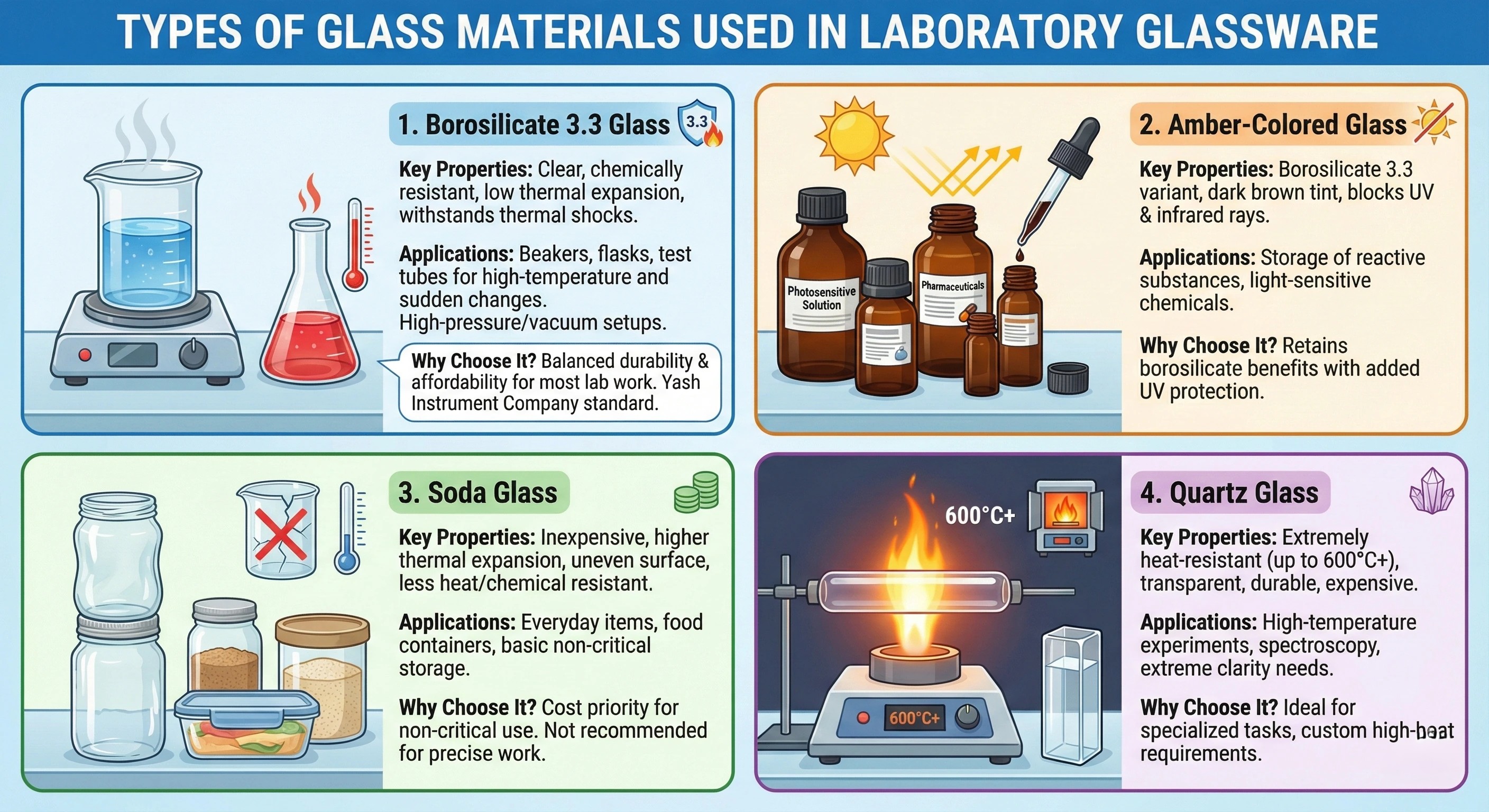
1. Borosilicate 3.3 Glass
- Key Properties: Transparent, chemically resistant, and capable of withstanding thermal shocks. It has a low coefficient of thermal expansion, making it ideal for high-temperature applications.
- Applications: Essential for beakers, flasks, and test tubes where heating is required.
- Why Choose It?: It is the industry standard (ISO 3585). At Yash Instrument Company, our core product line utilizes this premium material.
2. Amber-Colored Glass
- Key Properties: A variation of borosilicate glass tinted brown to block Ultraviolet (UV) and Infrared rays (up to 500nm).
- Applications: Storage of light-sensitive chemicals, vitamins, and pharmaceutical reagents.
3. Soda-Lime Glass
- Key Properties: More fragile and sensitive to thermal shock than borosilicate, but less expensive.
- Applications: Used for volumetric glassware (pipettes, burettes) that is not heated, as well as petri dishes and storage jars.
4. Quartz Glass (Fused Silica)
- Key Properties: Extremely high purity and heat resistance (up to 1000°C+). Transparent to UV light.
- Applications: Cuvettes for spectrophotometry and furnace tubes.
Common Laboratory Glassware & Their Applications
Understanding the material is step one; knowing which vessel to use is step two. Here are the staples found in every lab:
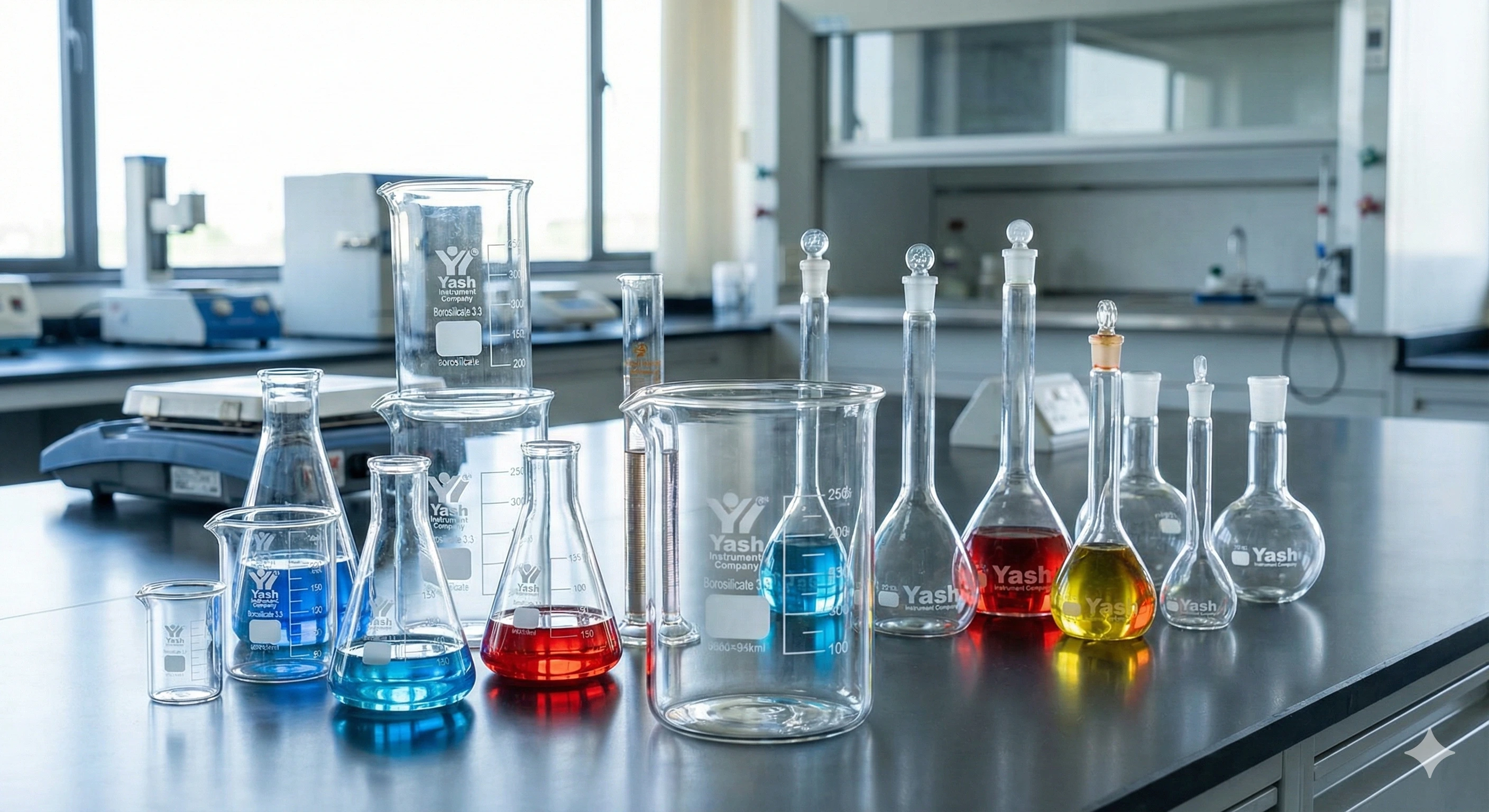
- Beakers: Cylindrical containers used for mixing, stirring, and heating liquids. Not suitable for precise measurements.
- Erlenmeyer Flasks (Conical Flasks): The narrow neck prevents splashing, making them perfect for titration and boiling.
- Volumetric Flasks: Calibrated to contain a precise volume at a specific temperature. Used for preparing standard solutions.
- Burettes & Pipettes: Long, graduated tubes used to dispense known volumes of liquids with high accuracy.
Care and Safety Tips for Lab Glassware
To extend the life of your equipment and ensure safety:
- Inspect Before Use: Never use chipped or cracked glassware, especially under vacuum or pressure.
- Gradual Heating: Even borosilicate glass can break if subjected to sudden, extreme temperature changes.
- Cleaning: Use appropriate brushes and non-abrasive detergents. For stubborn residues, chromic acid or ultrasonic baths may be used.
Conclusion
Selecting the right glassware ensures accuracy in results and safety in the laboratory. As one of India's trusted laboratory glassware manufacturers, Yash Instrument Company is committed to providing world-class solutions for your scientific needs.
Ready to place an order? Contact Us Today